

Passeig del Born
Passeig del Born, or Paseo del Borne in Castilian, is the long narrow rectangle of stone that runs from the old market to Santa Maria del Mar. It is wide enough to work as a square and enclosed enough to feel like a room, and the quarter has always used it as one: to sit, to meet, to let children run, to stand with a glass of wine in the evening and watch the light go off the church.
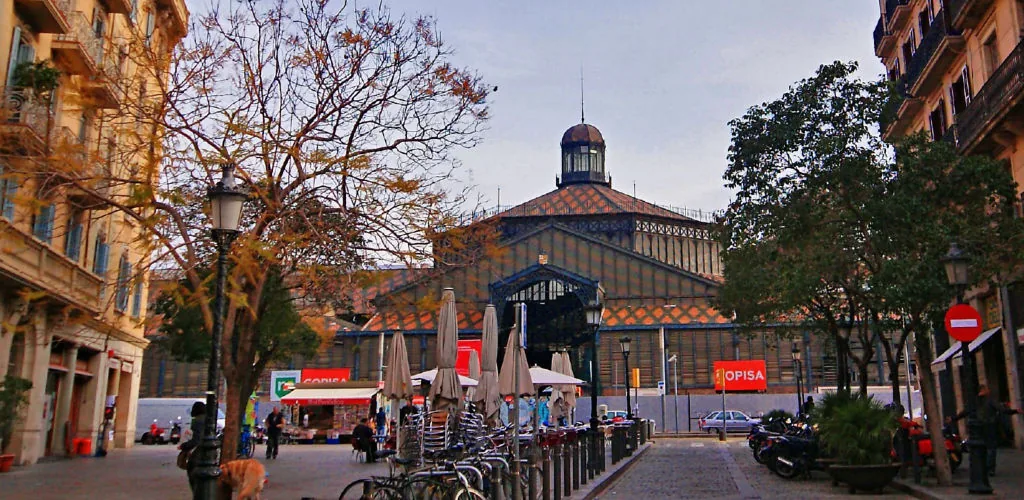
It is also where the neighbourhood's history is easiest to read in one look: the tournament ground under your feet, the church at one end and the market at the other.
What the name means
Born is an old Catalan word, and the sense that matters here is the one the dictionary of the Institut d'Estudis Catalans gives first: the enclosed ground on which tournaments were held. The avenue stands on that ground. The knights-in-armour telling of the story is the one every guide gives, and it is not wrong — the jousting was real, and it happened here at festival times — but what survives is more ordinary and much easier to see: a space closed on every side, long and narrow, laid out so that something could run in a straight line from one end to the other.
Three things you can check on the ground
The history of the Passeig is not in a museum. It is in the walls, the paving and the benches, and three things are worth knowing before you walk it.
1564, and the Inquisition
The first ceremonial auto de fe staged in Barcelona was held in the Born square in 1564, to mark a visit by Philip II, with the penitents processed to the Born for it. The square, rather than the avenue, is what the record names — which tells you what this ground was for. It was the quarter's stage for everything the city wanted witnessed, celebrations and punishments alike.
1714, and the houses that are no longer there
When the siege of Barcelona ended in 1714, the reprisals reshaped the quarter, and houses came down. The line the demolition reached is still marked on the Passeig: house number 18, which the Generalitat's Ruta 1714 signposts. It is the quietest monument in the neighbourhood — a number on a wall — and most people walk past it.
The cannon balls under the benches
The cannon balls you will notice along the avenue, numbered and sitting under the benches, are not siege relics left where they fell. They are an installation by the Barcelona artist and poet Joan Brossa, a memorial to 1714 — which is worth knowing, because it is exactly the sort of thing that gets retold wrong by the next person who sees them.
How the avenue is put together
Two cobbled paths run down the long sides, framing a wide paved centre that runs the length of the Passeig. The decorative lamp posts along the edges are worth a look in their own right — the ironwork is a small catalogue of what Catalan foundries could do. And then there are the benches, spaced the whole way down.
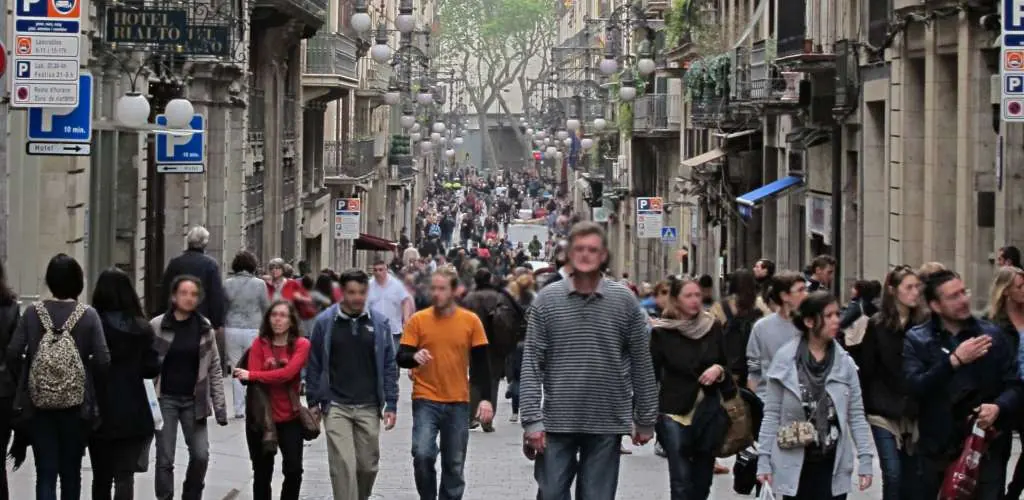
The benches are the reason the Passeig works as a place rather than a route. Sit on one and the entire avenue passes in front of you, which is what everybody does: locals with a newspaper, couples at the end of the evening, children using the wide centre as a running track. Most days a line of vendors spreads blankets of trinkets and toys along the paving and packs up when the light goes.
The two ends
Santa Maria del Mar
At one end stands the church the city calls the Cathedral of the Sea, built between 1329 and 1383. It was paid for by the parish rather than by a bishop or the crown, and the Bastaixos — the dockworkers who carried the stone up from Montjuïc — are depicted on the doors in memory of the people who did the work. Stand with your back to the church and the whole Passeig runs away from you towards the market; it is the best view of the avenue there is, and it costs nothing.
The Born Market
At the other end is the Born Market: an iron-and-glass hall of 1876, the first large iron-architecture building projected in Barcelona, with the excavated streets of the city before 1714 preserved beneath the floor. The building itself is free to enter. The exhibition is €3, the archaeological site €4.20, and a combined ticket €4.50; it closes on Mondays. For the hours, the annual closures and what is on, see our guide to the Born Market and MUHBA site.
Carrer de Montcada
A street behind the market end of the Passeig, Carrer de Montcada holds the Picasso Museum in the medieval palaces that line it. It is the street that shows you how the merchant city was actually built — courtyard behind courtyard, each one behind a stone doorway you would otherwise walk past — and it is a minute or two from the avenue, so there is no reason to choose between them.
Eating, drinking and the evening
Where the Passeig gives over to the square in front of Santa Maria del Mar, the cafés put out open-air tables. This is the best seat in the quarter for a glass of wine in the evening: you watch the local walkers, and the street performers who congregate at that end to play and dance.
The small shops along the avenue sell pizza by the slice and ice cream, and the benches are where people take them. For a proper meal, eating in El Born covers the quarter and our tapas bars and restaurants guide covers the counters worth queueing for. The bars and wine rooms around the Passeig are covered venue by venue, with hours and prices, in our nightlife guide to El Born — and the shopping streets behind the avenue are in shopping in El Born.
When to come
Early morning is the hour to have it to yourself. The light comes up the avenue from the church end, the cafés are still putting out chairs, and the square belongs to whoever is crossing it on the way to work.
Through the middle of the day the terraces fill and the benches are all taken. This is the Passeig as the quarter's living room, with the vendors out and nobody in a hurry.
The evening is the hour people come for. The terraces at the Santa Maria end fill first, the stone goes gold, and the performers set up in the middle of the paved centre with the length of the avenue as their audience. Stay for one drink after the light has gone and the lamp posts take over: it is the same square, and it is a different place.
Common questions
What does "born" mean?
The enclosed ground where tournaments were held — the jousting field. The avenue stands on it, and the name is the only part of the tournament that is still there.
What is there to see on Passeig del Born?
The avenue itself, which is the point: two cobbled side paths, a wide paved centre, the lamp posts and the benches. At the ends, Santa Maria del Mar and the Born Market; behind the market end, Carrer de Montcada and the Picasso Museum. Along the way, the Brossa cannon balls under the benches and the demolition marker at number 18.
Do you have to pay to visit?
No — it is a public street and a public square, and there is nothing to buy to walk it. The Born Market building is free; its exhibition is €3 and the archaeological site €4.20.
How long should you allow?
You can walk the whole length in less time than it takes to drink a coffee, but the point is to stop. An hour covers the avenue, the church and a drink; half a day covers it plus the market and the Picasso Museum.
More on El Born
The complete guide to El Born puts the Passeig in the context of the whole quarter, and things to do in El Born covers what else is within a few minutes of it. If you are arriving, how to get to El Born has the metro, airport and walking routes — Jaume I is five minutes from the avenue.